DigiByte vs Bitcoin (2026): Speed, Security & Which Blockchain Is Technically Superior?
DigiByte vs Bitcoin in 2026. Compare speed, mining algorithms, security, decentralisation and real-world utility in this analysis.
DigiByte vs Bitcoin: Which Is Actually Better in 2026?
For over a decade, Bitcoin has dominated the cryptocurrency landscape. It was the first successful decentralised digital currency, the first to solve the double-spend problem at scale, and the first to prove that a blockchain could operate securely without central authority.


But 2026 is not 2012.
The blockchain industry has matured. Investors are more educated. Miners are more strategic. Developers are more demanding.
And that raises a serious question:
Is Bitcoin Still Technically Superior — Or Has DigiByte Quietly Built Something More Advanced?
This is not a tribal argument. This is not maximalism. This is a structural, technical comparison between two blockchain networks with very different design philosophies.
Origins and Philosophy
Bitcoin launched in 2009 as a revolutionary alternative to central banking. Its primary mission was simple: create sound digital money without trust in intermediaries.
DigiByte launched in 2014 with a different mindset. It was built not only to preserve value but to improve speed, scalability, and mining decentralisation at the base layer.
Bitcoin focused on security first and scaling later.
DigiByte focused on security, speed, and distribution simultaneously.
Both approaches have merit. But the results are fundamentally different.
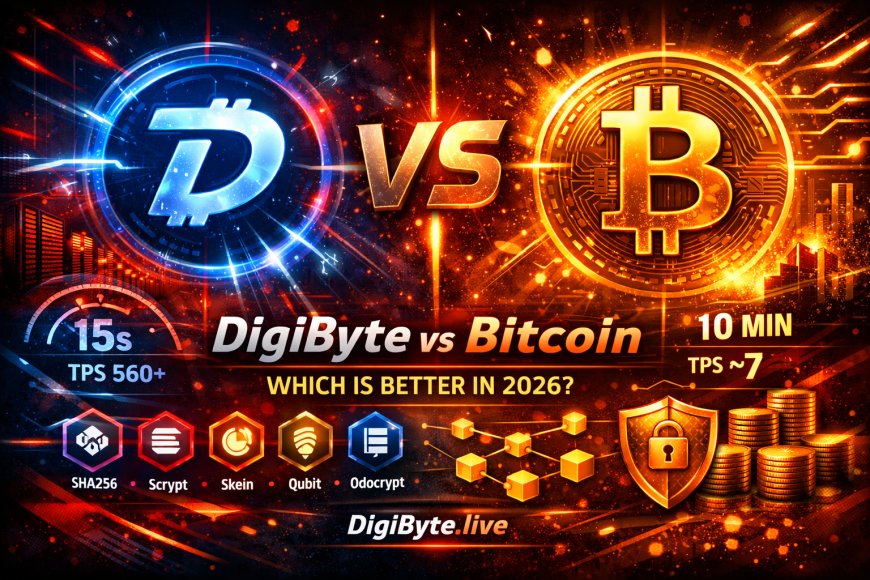
Block Speed: 15 Seconds vs 10 Minutes
Bitcoin produces one block every 10 minutes.
DigiByte produces one block every 15 seconds.
This difference dramatically affects usability.
| Feature | DigiByte | Bitcoin |
|---|---|---|
| Block Time | 15 seconds | 10 minutes |
| Transactions Per Second | 560+ | ~7 |
| Average Confirmation Speed | Under 1 minute | 30–60 minutes (for high security) |
Faster block times mean faster confirmations. That matters for:
- Retail payments
- Online transactions
- Exchange transfers
- Smart contract integrations
Bitcoin increasingly relies on Layer 2 solutions such as Lightning for speed. DigiByte’s speed exists directly on Layer 1.
If Bitcoin were launched today, would developers still choose 10-minute blocks?
That is a legitimate design question.
Mining Architecture: 5 Algorithms vs 1
Bitcoin uses one mining algorithm: SHA-256.
DigiByte uses five:
- SHA256
- Scrypt
- Skein
- Qubit
- Odocrypt
This multi-algorithm system was designed to prevent mining centralisation and reduce the risk of a single hardware monopoly dominating the network.
Bitcoin mining has gradually industrialised. Large-scale operations dominate hash power. Access to cheap energy and advanced ASICs has created significant consolidation.
DigiByte’s multi-algorithm approach distributes risk across hardware types and communities.
It encourages broader participation.
If you are considering mining DigiByte, read:
Solo Mining DigiByte: Is It Worth It in 2026?
Pool Mining DigiByte: Is It Worth It in 2026?
Difficulty Adjustment: Real-Time vs Two Weeks
Bitcoin adjusts mining difficulty every 2016 blocks, approximately every two weeks.
DigiByte uses DigiShield and MultiShield, which adjust difficulty in near real time.
This allows DigiByte to respond immediately to sudden hash rate spikes or drops.
That protects against:
- Hash rate manipulation
- Multipool hopping
- Sudden mining centralisation
- Block timing instability
For a deep technical explanation, read:
What Is DigiShield? DigiByte’s Real-Time Difficulty Adjustment Explained
This mechanism was so effective that other blockchains later adopted variations of it.
Security and Decentralisation
Security is not just about hash rate. It is about distribution.
Bitcoin has immense hash rate security. However, mining pools and industrial farms now control a significant percentage of block production.
DigiByte’s five-algorithm structure spreads risk across different mining ecosystems.
No single algorithm dominates the entire chain.
From a pure architectural standpoint, diversification increases resilience.
Scalability and Real-World Use
Bitcoin increasingly functions as digital gold. It is designed to be held, not spent frequently.
DigiByte’s faster confirmations and throughput make it more suited for:
- Point-of-sale transactions
- Online commerce
- High-frequency transfers
- Global microtransactions
Layer 1 efficiency matters when adoption scales globally.
Market Position and Institutional Adoption
Bitcoin dominates in brand recognition and institutional presence. ETFs, treasury allocations, and corporate balance sheet holdings reinforce its position.
DigiByte operates as a grassroots-driven project without corporate backing.
This has advantages and disadvantages.
Bitcoin has capital and recognition.
DigiByte has flexibility and community autonomy.
The Power of Community
DigiByte has maintained one of the most active grassroots communities in cryptocurrency.
Its decentralised growth model has allowed it to survive multiple market cycles without venture capital control.
Learn more here:
The Massive DigiByte Community Thriving on X
Is DigiByte Undervalued?
Markets do not always reward technical superiority immediately.
Speculation, liquidity, narrative, and macroeconomics often dominate pricing cycles.
However, long-term infrastructure value tends to resurface over time.
Read the full analysis:
Is DigiByte the Most Undervalued Blockchain in Crypto?
The Honest Conclusion
If your priority is institutional adoption and brand dominance, Bitcoin remains unmatched.
If your priority is speed, architectural innovation, mining distribution, and real-time difficulty adjustment, DigiByte presents a compelling alternative.
They are not identical competitors.
They are different design philosophies solving related problems.
The more important question is whether markets eventually reward decentralised technical innovation — or continue rewarding brand dominance.
2026 may be the year that answer begins to shift.