
What Is Scrypt Mining? DigiByte’s Scrypt Algorithm Explained (2026 Guide)
Scrypt mining explained in plain English. Learn what Scrypt is, why DigiByte uses it as one of its MultiAlgo lanes, what hardware mines it (ASICs), and how pool vs solo mining works in 2026.
What Is Scrypt Mining? DigiByte’s Scrypt Algorithm Explained (2026 Guide)
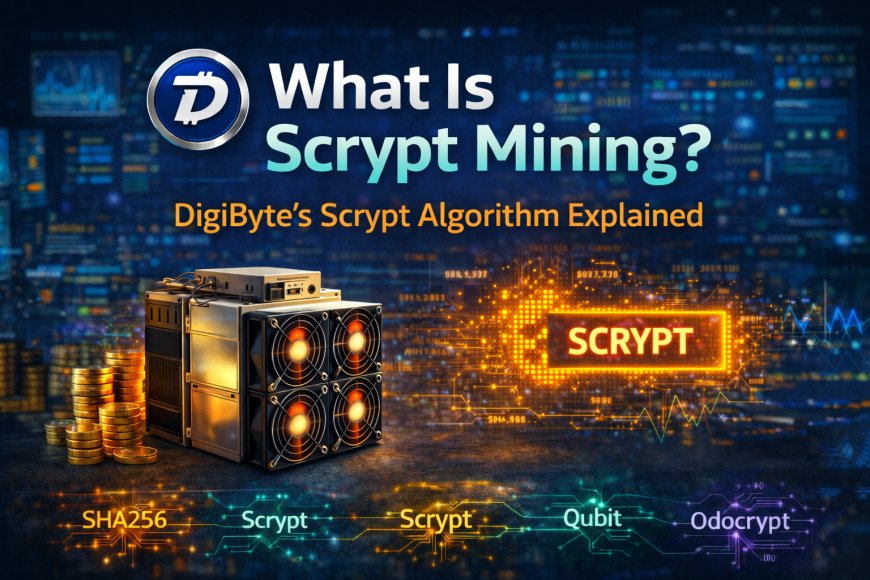
Scrypt mining means mining using the Scrypt hashing algorithm. On DigiByte (DGB), Scrypt is one of the network’s five Proof-of-Work algorithms — alongside SHA256, Skein, Qubit, and Odocrypt.


Scrypt is best known because it powers Litecoin-style mining, which is why most competitive Scrypt mining today is done with dedicated Scrypt ASIC miners. On DigiByte, Scrypt is one of several mining lanes, helping spread mining participation across multiple algorithms for stronger decentralization.
In one sentence: Scrypt mining is Proof-of-Work mining using the Scrypt algorithm, typically done with ASIC hardware in 2026.
Quick Links (Recommended Reading on DigiByte.live)
Jump to any guide:
Core mining guides:
What Is the Scrypt Algorithm?
Scrypt is a cryptographic hashing algorithm designed to be more memory-intensive than SHA256. In mining terms, that means the work isn’t only about raw hashing speed — memory handling also matters (at least in the original design goals).
In Proof-of-Work mining, the concept is the same as other algorithms:
- Miners repeatedly compute hashes of candidate block data
- They search for a valid solution that matches the network difficulty target
- When a miner finds a valid solution, it can produce a block
On DigiByte, Scrypt is simply one of the five mining “lanes” securing the network.
Why DigiByte Uses Scrypt
DigiByte uses MultiAlgo so the network isn’t dependent on a single mining ecosystem. Scrypt is one of the most established mining ecosystems in crypto, which makes it a strong addition to DigiByte’s overall security design.
Scrypt’s role in DigiByte helps:
- diversify mining participation across different hardware ecosystems
- increase resilience if another algorithm’s hashrate shifts
- support decentralization by spreading mining across multiple lanes
How Scrypt Mining Works on DigiByte
Scrypt miners compete only in the DigiByte Scrypt lane:
- Your miner builds candidate block data
- It hashes using the Scrypt algorithm
- If it finds a valid solution, it submits the block
- The network verifies it and the block reward is issued
Same Proof-of-Work concept — different algorithm.
What Hardware Mines Scrypt?
In 2026, competitive Scrypt mining is typically done with dedicated Scrypt ASIC miners. These are the same class of miners commonly used for Litecoin/Dogecoin style mining.
Key reality: power and heat are the real challenges
Scrypt ASICs can be extremely powerful, but they often come with:
- high power draw (large daily electricity costs)
- serious heat output (cooling/ventilation required)
- high noise (many are not “home friendly” without planning)
If you’re thinking about Scrypt mining at home, your limiting factor is usually not “hashrate” — it’s where the heat goes and whether the noise is tolerable.
Rule of mining: A Scrypt miner that you can’t cool properly will throttle, crash, or die early. Cooling is not optional — it’s part of the hardware.
Scrypt Mining: Pool vs Solo
Pool vs solo depends on your hashrate and your tolerance for variance. Most miners choose pools for consistency.
Pool mining (most people)
- more consistent payouts
- less variance
- best for small and mid-sized miners
Solo mining (high variance)
- you either find blocks or you don’t
- can be inconsistent unless you have significant hashrate
- can feel like “lottery mode” for smaller setups
Deep dives:
- Pool Mining DigiByte (DGB): Is It Worth It in 2026?
- Solo Mining DigiByte (DGB): Is It Worth It in 2026?
Why Difficulty Matters (DigiShield)
Mining profitability isn’t fixed. When more miners join Scrypt, difficulty rises and each miner’s share of rewards typically drops. When miners leave, difficulty can fall.
DigiByte is known for fast difficulty adjustment (often discussed under DigiShield), which helps the network respond quickly to hashrate changes.
Related reading:
Is Scrypt Mining “Worth It” in 2026?
Scrypt mining can be worth it if:
- you have efficient Scrypt ASIC hardware
- your electricity cost is low enough
- you can run safely (cooling, circuits, noise)
- you pick pool vs solo based on your risk tolerance
Scrypt can be very competitive, so for most miners the deciding factors are electricity price, miner efficiency, and uptime.
Quick FAQ
Is Scrypt mining the same as Litecoin mining?
The algorithm is the same (Scrypt), and the hardware is often the same class (Scrypt ASICs). But you’re mining on DigiByte’s Scrypt lane, which is one part of DigiByte’s MultiAlgo system.
Can I mine Scrypt with a GPU?
Not competitively in most real-world conditions. Scrypt is dominated by ASICs where they are widely available.
Does Scrypt mining help DigiByte?
Yes. All five mining lanes contribute to overall network security and decentralization.
Bottom Line
Scrypt mining is Proof-of-Work mining using the Scrypt algorithm. On DigiByte, it’s one of five mining lanes that collectively secure the network through MultiAlgo design. In 2026, Scrypt mining is typically ASIC-driven, and the winners are decided by efficiency, power cost, cooling, and uptime.
Call to Action
Want a realistic Scrypt mining plan? Tell me your electricity price per kWh and what miner you have (model + watts), and I’ll suggest the most sensible approach.