
Real-World DigiByte Use Cases: Where DGB, Digi-ID and DigiAssets Could Actually Matter
Explore real-world DigiByte use cases across payments, identity, tokenization, audit trails, e-commerce, gaming and supply chains in 2026.
Real-World DigiByte Use Cases: Where DGB, Digi-ID and DigiAssets Could Actually Matter
One of the biggest mistakes in crypto is assuming a blockchain only matters if it becomes the centre of the whole financial system overnight. Real adoption rarely works like that. It usually starts in narrow, useful niches. A network solves one real problem, then another, then another, until people stop asking whether the technology is “the future” and simply start using it because it works.


That is the right way to think about DigiByte.
DigiByte has never been the loudest project in crypto, and that may be part of the reason so many people still underestimate it. It is often discussed only as a coin, a market chart, or a community favourite. But if you zoom out and look at what the stack is actually built to do, the conversation becomes much more interesting. DigiByte is not just about sending DGB from one wallet to another. It is also about fast settlement, low-cost transfers, passwordless authentication with Digi-ID, digital asset issuance with DigiAssets, and building applications on top of an older, battle-tested proof-of-work network.
The more important question is not, “Can DigiByte do amazing things in theory?” Almost every blockchain looks amazing in theory. The question is this: where does DigiByte make practical sense in the real world?
That is what this article is about.
We are going to look at the use cases that feel the most realistic, the most commercially understandable, and the most aligned with what DigiByte already offers. Not fantasy. Not empty hype. Not “everything will be on-chain tomorrow.” Just practical areas where DigiByte could genuinely fit.
DigiByte’s real advantage: practical infrastructure, not just speculation
Before talking about use cases, it helps to understand why DigiByte is even worth considering as infrastructure in the first place.
Most blockchains get judged by price action, influencer attention, or exchange narratives. But businesses do not adopt infrastructure because it trends for a few weeks. They adopt systems that are reliable, understandable, relatively low cost, and hard to break.
DigiByte’s appeal comes from a few simple characteristics:
- Fast block times and quick confirmations for everyday transfers
- Low transaction costs, which matter far more than people think in real payment environments
- A proof-of-work base layer with a long operating history
- Five mining algorithms aimed at improving resilience and decentralisation
- Digi-ID for passwordless authentication
- DigiAssets for token issuance and digital representations of value
- An open-source, community-led structure that reduces dependence on a single company
That combination makes DigiByte interesting because it sits in an unusual middle ground. It is not trying to be a hype-first meme chain. It is not trying to out-market every smart contract giant. It is also not trying to reinvent itself every six months. DigiByte feels more like practical blockchain plumbing. That is not as flashy, but real businesses often care more about plumbing than fireworks.
So where could that plumbing be useful?
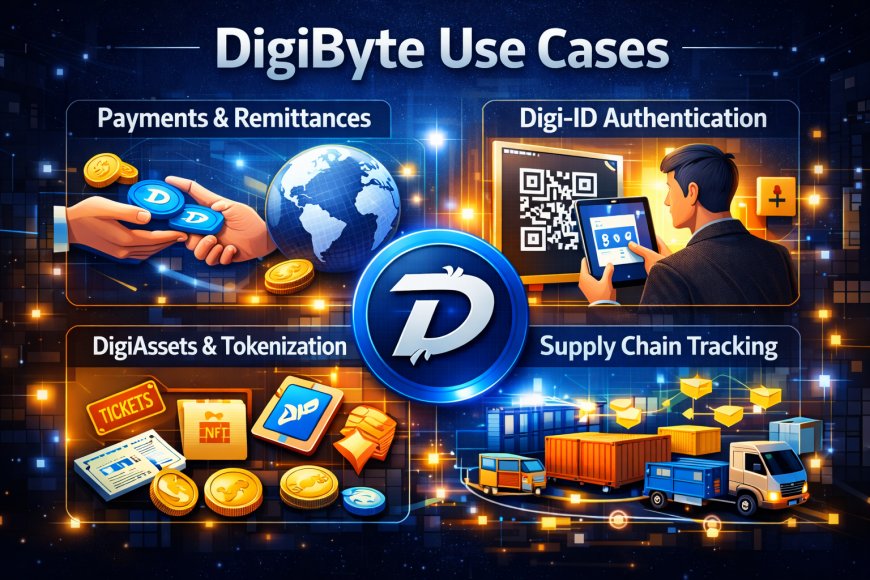
1. Everyday payments and peer-to-peer value transfer
The most obvious real-world use case for DigiByte is still one of the most important: payments.
Crypto people sometimes roll their eyes at the “digital cash” use case because it sounds too simple, but simple is exactly why it matters. A fast, low-fee network is immediately useful if it lets people move value without asking permission, without waiting too long, and without losing too much to fees.
DigiByte fits naturally into this conversation.
For everyday transfers, the ideal payment asset is not just one that exists on an exchange. It needs to be easy to send, cheap to settle, and practical for smaller amounts. If transaction costs are high, everyday payments stop making sense. If confirmation times feel slow, the user experience breaks down. If using the network feels technical or stressful, ordinary people will not bother.
DigiByte has long appealed to users who want something quicker and lighter for basic transfers. That matters for online tipping, direct payments between users, community commerce, small digital purchases, donations, and cross-border transfers where speed and cost both matter.
Imagine a creator taking support directly from their community. Imagine a small online business that wants a second payment option outside the card system. Imagine two people in different countries settling a small invoice without involving multiple intermediaries. These are not futuristic examples. These are ordinary commerce scenarios that happen every day.
For DigiByte, the opportunity is not pretending DGB replaces every national payment rail tomorrow. The opportunity is being the option that works well enough, cheaply enough, and quickly enough for people who want another route.
That is especially true for independent businesses and crypto-native brands. A merchant does not need global adoption to benefit from adding one more payment method. They only need enough users who want to pay that way.
2. Cross-border transfers and remittances
Closely connected to payments is remittance.
This is one of the few crypto use cases that has always made sense in plain English. If someone is sending money across borders, they care about cost, speed, reliability, and ease of access. Traditional remittance systems are improving, but fees are still a serious issue in many corridors, especially for people sending smaller amounts.
That is where fast, low-fee blockchains remain relevant.
DigiByte is not the only network that can play in this space, but it has characteristics that make it credible. If the goal is to move value quickly between two people who already understand how to use wallets, then DigiByte can do the job without trying to be overly complicated.
It is important to be honest here. Remittance adoption is not just about the chain. It also depends on on-ramps, off-ramps, local regulation, wallet usability, and whether the sender and receiver can actually convert in and out easily. That is why no blockchain wins this use case on technology alone.
Still, DigiByte has a place in the conversation because lower-fee transfer rails matter. In a world where many households are sending modest sums, shaving off cost is not a small detail. It is the use case.
Even if DigiByte only serves niche corridors, community-based transfers, or crypto-friendly user groups, that is still a real-world use case. Adoption does not have to be universal to be meaningful.
3. Merchant payments for online stores and service businesses
Merchant adoption is where payments become more tangible.
It is one thing for holders to say a coin is useful. It is another for a business to put a “Pay with DGB” option on checkout and actually take revenue that way.
The good news for DigiByte is that this use case does not require some giant multinational partnership to matter. It works from the bottom up. Small stores, digital service providers, community businesses, online brands, donation-driven projects, educational platforms, gaming communities, and membership sites can all experiment with crypto payments in manageable ways.
This matters because low-friction adoption often starts with small merchants who are more flexible than major corporations. They do not need a year of committee meetings. They just need a payment option that functions, integrates, and does not create more problems than it solves.
In practice, DigiByte works best here when paired with an existing payment gateway or crypto payment processor. That removes a lot of technical burden from the merchant and lets them focus on whether their customers actually want to pay with DGB.
There is also a strong branding angle. For crypto-focused stores and community-led platforms, accepting DigiByte sends a signal. It says the business supports older, decentralised proof-of-work networks, values optionality, and is open to peer-to-peer settlement. For some audiences that matters.
And because DigiByte transactions are generally lightweight and affordable, smaller purchases make more sense than they do on more expensive chains. That opens the door to merch sales, subscriptions, article tips, gated communities, software licences, and micro-donations.
4. Microtransactions and low-value digital commerce
One of the most under-discussed opportunities in crypto is small digital commerce.
Not everything online costs £50 or £500. A lot of internet activity lives in the low-value range: paying for an article, unlocking a premium comment section, sending a tip, buying a digital download, accessing a private community, grabbing a cheap in-game item, or supporting a creator with the equivalent of a coffee.
This is where network design becomes very important.
If the cost of moving value is too high, small transactions stop working. If settlement is clunky, users abandon the flow. If the wallet experience is poor, conversion drops. So when people talk about blockchain use cases, they often skip over one of the most obvious categories: networks that are simply good enough for small-value internet payments.
DigiByte has a strong fit here because the economics are more realistic. A user can send a small amount without the transfer feeling absurd. That matters for online platforms that want to experiment with monetisation beyond advertising, card processors, and platform gatekeepers.
Imagine a publisher charging tiny amounts for premium guides. Imagine a creator community where members can tip each other directly. Imagine a gaming site where low-value rewards and entry fees move instantly. These are not impossible concepts. The internet has wanted easy microtransactions for years. It just keeps running into cost, friction, and platform dependency.
DigiByte cannot solve every part of that on its own. But it can provide a more suitable rail than networks where tiny transfers are economically pointless.
5. Passwordless login and account security with Digi-ID
This is one of the most interesting real-world use cases in the entire DigiByte ecosystem, and it deserves more attention.
Digi-ID is not about price speculation. It is about authentication.
That alone makes it valuable because authentication is a real pain point on the internet. Passwords are weak, reused, phished, leaked, forgotten, and constantly attacked. Two-factor systems help, but they also add friction and are still not perfect. Businesses spend huge amounts of time dealing with login security, account recovery, fraud prevention, and user frustration.
Digi-ID approaches that problem differently by enabling a user to authenticate through a cryptographic process rather than relying purely on old-fashioned usernames and passwords.
That creates a very practical set of possible use cases:
- Logging into websites and web apps
- Securing admin dashboards
- Adding stronger authentication for e-commerce back ends
- Protecting membership sites and communities
- Reducing password reset headaches
- Improving security for high-risk user accounts
The beauty of Digi-ID is that it does not need mass consumer awareness to matter. It only needs developers and site owners who understand the value of better authentication.
This is exactly the kind of use case that could make sense for crypto-native platforms, privacy-focused communities, independent publishers, and specialist membership businesses. If someone runs a WordPress site, an educational portal, a crypto dashboard, or a members-only service, the idea of passwordless or enhanced cryptographic login is not just cool. It is commercially sensible.
That is also why Digi-ID feels more grounded than many “Web3 identity” ideas. It is not trying to become some giant social scoring layer or force every person into a bloated metaverse identity stack. It is solving a simple and costly problem: how to log in more safely.
6. Identity, credentials, and selective proof
Once you move past simple login, the next natural use case is digital identity and verifiable credentials.
This is a bigger category than many people realise. It covers things like proving age, proving membership, proving qualifications, proving access rights, proving event attendance, proving account ownership, and proving that a document or credential came from a trusted issuer.
Now, to be clear, DigiByte is not currently the dominant digital identity standard in the world. But the wider trend is moving in this direction. Governments, enterprises, and software providers are all looking more seriously at portable digital credentials, privacy-respecting identity systems, and user-controlled ways to prove facts without oversharing personal data.
That matters because DigiByte already has an identity-related foundation through Digi-ID and a wider ecosystem logic that fits selective proof, verification, and digital trust.
In practical terms, that could mean:
- A training company issuing completion certificates with on-chain verification hooks
- A private members club issuing access credentials
- An event organiser using verifiable attendance passes
- A community platform proving contributor status without exposing unnecessary personal information
- A business verifying the integrity of employee or contractor credentials
Again, the key is not to oversell. DigiByte does not need to become the identity layer for every nation-state to have real utility here. It only needs to be good enough for targeted implementations where auditability, cryptographic proof, and user control matter.
That is a very different and much more realistic standard.
7. Document timestamping and audit trails
Another strong use case for DigiByte is document timestamping.
This is not always the sexiest topic in crypto, but it is one of the easiest to explain to a real business. Sometimes the goal is not to put an entire document on-chain. The goal is to create proof that a document existed in a certain state at a certain time.
That can be useful for:
- Contracts
- Research notes
- Creative work
- Compliance records
- Intellectual property drafts
- Internal approvals
- Inventory or maintenance records
For organisations that care about auditability, a blockchain-based timestamp can add an extra layer of integrity. It does not magically solve every legal dispute, and it does not replace proper document management. But it can strengthen proof, reduce ambiguity, and create tamper-evident records.
DigiByte makes sense for this because the use case benefits from a stable, low-cost, public chain. You do not need expensive execution logic for simple timestamping. You need reliability, permanence, and affordability.
This is also one of the most realistic bridges between crypto and non-crypto industries. A law firm, design studio, compliance team, manufacturer, or independent creator may not care about token speculation. But they absolutely care about proving that a record existed before someone else altered, copied, or disputed it.
That is where DigiByte can quietly make sense.
8. Tokenisation with DigiAssets
If Digi-ID is one side of DigiByte’s practical value, DigiAssets is the other big one.
DigiAssets expands the conversation beyond simple coin transfers by allowing digital assets to be issued on top of the DigiByte blockchain. This is where the ecosystem becomes much more interesting because it opens the door to representing value, rights, access, ownership, or identity-linked items in token form.
Now this is exactly the area where a lot of crypto content becomes silly. People immediately jump to “everything in the world will be tokenised.” That is too broad, too vague, and not useful. A smarter approach is to ask what kinds of assets or rights are most likely to be represented digitally first.
That usually includes things like:
- Tickets
- Membership passes
- Collectibles
- Reward points
- Digital certificates
- Proof-of-attendance items
- Limited access products
- Branded community assets
These are sensible because they are digitally native or semi-digital already. They do not require the whole legal and regulatory burden of fully tokenising a skyscraper before the technology can be useful. They are smaller, easier, and more commercially testable.
For DigiByte, that matters a lot. It means DigiAssets does not have to begin with giant institutions. It can begin with communities, brands, events, publishers, game projects, creators, and independent businesses that want programmable digital items without relying on a central database alone.
9. Loyalty programmes, memberships, and community rewards
One of the clearest DigiAssets opportunities is loyalty and membership systems.
Traditional loyalty points are everywhere, but they are usually trapped inside centralised databases. Users cannot easily verify them, move them, or understand the rules around them. In many cases, the programme is just a spreadsheet with branding.
Tokenised loyalty is not automatically better, but it can become more flexible and transparent.
A business or community could issue reward tokens for purchases, referrals, participation, event attendance, or content contributions. Those tokens could then unlock discounts, special access, early product drops, premium areas, or community status.
This is especially relevant for online communities because membership is no longer just about a username in a database. It can become portable, provable, and tradable if the issuer wants it to be.
Think about a media platform rewarding top contributors. Think about a conference issuing premium access badges. Think about a creator brand launching a members club with token-based tiers. Think about a merchant giving digital reward units that can be redeemed later or used to enter raffles and special events.
These are all understandable business ideas. They do not require the public to understand every technical detail. They just need the end-user experience to feel smooth.
And because DigiByte has a community-first culture, this use case feels especially natural. Loyalty, contribution, reputation, and access are things communities care about deeply.
10. Event tickets and anti-counterfeit access passes
Ticketing is another practical use case that crypto keeps revisiting because the problem is real.
Fake tickets, duplicated QR codes, scalping issues, opaque resale rules, and poor attendee data all create friction for organisers and fans. A blockchain-based asset layer can help by making tickets more traceable, more programmable, and easier to verify.
This does not mean every concert on Earth needs to move on-chain tomorrow. But for niche events, community conferences, private meetups, digital summits, and crypto-native gatherings, a DigiAssets-based ticket or access pass makes a lot of sense.
The value here is not just resale logic. It is also proof of authenticity. An organiser can issue a limited number of verifiable passes. Attendees can show they hold a genuine pass. Communities can create collectible attendance records or grant future perks to past attendees.
That turns a ticket from a disposable barcode into a programmable access asset.
Even if only a small number of projects use DigiByte this way, it is still a real-world application because it solves a genuine operational problem while creating better fan and community experiences.
11. Supply chain traceability and product authenticity
When businesses talk about blockchain utility, supply chain traceability comes up for a reason. It is one of the clearest areas where distributed records can add value.
Supply chains are messy. They involve handoffs, documents, approvals, origin claims, warehouse movements, inspections, and multiple parties that may not fully trust each other. That creates room for delay, error, and fraud.
A blockchain will not solve every supply chain problem by itself, but it can strengthen traceability and auditability. That is particularly useful when businesses need better proof of where something came from, when it moved, what checks were applied, and whether a record has been changed.
DigiByte could fit this space in a few ways:
- Timestamping key handoff records
- Anchoring product authenticity claims
- Supporting token-linked certificates or batch records
- Verifying warranty or maintenance histories
- Tracking high-value or limited-run goods
This may be more realistic in specialist or premium markets than in every mass retail chain. Luxury goods, specialty manufacturing, collectibles, artisan products, and parts verification are easier starting points than trying to rebuild global logistics overnight.
Still, the use case is important because it shows that DigiByte does not only belong in finance. It can also function as integrity infrastructure for records tied to physical goods.
12. Real-world asset tokenisation: possible, but only where it is legally clear
One of the boldest use cases discussed across the blockchain industry is real-world asset tokenisation. This covers the digital representation of claims tied to assets such as property, debt instruments, commodities, funds, invoices, and other forms of ownership or entitlement.
DigiAssets makes this conversation relevant for DigiByte, but it is very important to handle the subject carefully.
Technically, representing an asset is one thing. Legally and operationally enforcing the rights behind that asset is another. That is why tokenisation should never be discussed as if creating a token automatically creates a compliant market. It does not.
Even so, the direction of travel across finance is obvious. More institutions are exploring tokenised representations of real-world value because better settlement, programmability, auditability, and fractional ownership can all offer advantages in the right contexts.
For DigiByte, the sensible approach is not to claim it will dominate institutional tokenisation. The sensible approach is to recognise that DigiAssets gives builders a framework for asset issuance, and that this framework could be valuable in controlled, niche, or community-level implementations where legal structures are clear.
Examples might include:
- Private membership shares in a club or association
- Digitally represented vouchers or redeemable claims
- Fractional access rights to a community-owned initiative
- Local funding models with clearly defined terms
- Specialist platforms experimenting with transparent issuance and transfer rules
The key phrase is where legal rights are clearly mapped. Without that, tokenisation is just branding. With that, it becomes much more interesting.
13. Gaming, digital collectibles, and online communities
Gaming and online communities are often much better fits for blockchain than traditional enterprises because the users are already digital, already global, and often already comfortable with virtual items and digital identity.
That makes DigiByte relevant in several ways.
DGB itself can work for prizes, tips, and entry fees. DigiAssets can support collectibles, passes, badges, reward units, and community items. Digi-ID can strengthen account access and identity-linked features. Put together, that creates a toolkit that is more useful than many people realise.
For example, a game or community platform could use DigiByte for:
- Reward payouts
- Tournament entry
- Premium access passes
- Collectible digital items
- Seasonal badges and proof-of-participation assets
- Community reputation systems tied to provable ownership
The important thing here is that not every use case needs to be worth millions to matter. Some of the healthiest crypto infrastructure growth comes from smaller ecosystems where a few thousand engaged users actually use the tools. That is often more meaningful than a giant press release with no real activity behind it.
DigiByte’s community roots make it well suited to these kinds of bottom-up experiments.
14. Charity, donations, and transparent campaign flows
Another strong real-world use case is donations.
Many charities, campaigns, creators, and independent projects struggle with the same issue: supporters want a simple way to contribute, and in many cases they also want a clearer line of sight into where funds are going.
DigiByte can help with the payment side immediately by enabling direct wallet-based contributions. In some cases, DigiAssets and timestamped records could also support more transparent campaign structures, milestone proofs, or donor reward systems.
This is particularly appealing for grassroots fundraising, community relief efforts, open-source development support, and independent media projects. These groups often care about low fees, global reach, and less dependence on traditional gatekeepers.
Of course, transparency does not happen automatically. A project still has to publish addresses, explain fund use, communicate clearly, and operate honestly. Blockchain only makes some forms of verification easier. It does not replace trust completely.
But that still matters. Easier verification is useful. In a world where trust is expensive, better proof has value.
15. Business records, workflow proof, and operational integrity
Some of DigiByte’s best use cases may never become headline-grabbing stories because they live behind the scenes.
A lot of business value comes from quiet improvements in recordkeeping, verification, and process integrity. A company may not publicly shout that it is using blockchain, but if a blockchain helps reduce disputes, improve auditability, or harden a workflow, that is still adoption.
For DigiByte, this could include:
- Proof that a report was finalised at a certain time
- Evidence that a maintenance step was completed
- Batch verification for internal manufacturing records
- Anchoring compliance logs
- Verification for software release records or development milestones
These are boring on the surface, but businesses pay money to solve boring problems. In fact, boring problems are often the best business opportunities because they are ongoing, expensive, and operationally painful.
If DigiByte can quietly become a trusted verification rail in niche operational contexts, that is a meaningful real-world use case regardless of whether the public notices.
What could slow DigiByte adoption?
To keep this article honest, we also need to discuss the limitations.
DigiByte has real utility potential, but potential is not the same thing as execution. Several factors can slow adoption:
- Limited mainstream awareness compared with larger chains
- Smaller developer mindshare
- Fewer integrations than dominant ecosystems
- A market that often rewards hype over infrastructure
- The need for simpler user experiences around wallets and onboarding
- Regulatory complexity in areas like asset tokenisation and identity
These challenges are real. There is no point pretending otherwise.
But they also help define the smartest path forward. DigiByte does not need to copy every other chain. It does not need to win every narrative cycle. It does not need to promise impossible things. It needs focused builders, clean use cases, better user-facing tools, and examples that ordinary people can understand.
In other words, DigiByte’s next stage is probably not won by shouting louder. It is won by shipping practical things.
The smartest adoption path for DigiByte
If you strip away the noise, DigiByte’s strongest path looks something like this:
- Own the practical digital cash niche with fast, low-cost payments and direct peer-to-peer transfers.
- Push Digi-ID harder as a genuine answer to web login pain and account security.
- Promote DigiAssets through understandable business cases like memberships, tickets, rewards, certificates, and digital access.
- Target communities, creators, small merchants, and specialist businesses first instead of waiting for giant institutions to validate everything.
- Focus on proof, integrity, and usability rather than chasing every passing trend.
That path may sound less dramatic than some crypto roadmaps, but it is much more believable.
Final thoughts: DigiByte does not need to be everything to be valuable
The real-world case for DigiByte is stronger than many people think, but only if we talk about it honestly.
DigiByte does not need to replace every bank, beat every smart contract platform, or absorb the whole internet to matter. It only needs to become useful in areas where its design actually fits the job.
And when you look at those areas carefully, there is quite a lot on the table.
Payments. Merchant checkout. Remittances. Microtransactions. Passwordless login. Verifiable digital access. Tokenised memberships. Loyalty systems. Tickets. Audit trails. Timestamping. Product authenticity. Specialist asset issuance. Gaming communities. Transparent donations. Operational integrity.
That is not a tiny list.
The common theme is trust with less friction. Moving value more easily. Proving something without depending entirely on a middleman. Creating digital assets with clearer rules. Giving users more control over access and ownership. Hardening records that should not be quietly altered later.
That is where DigiByte starts to look less like “just another old coin” and more like a practical blockchain toolkit waiting for more builders to use it.
Will every use case explode tomorrow? No.
Will all of them succeed? Also no.
But that is not the point.
The point is that DigiByte already has the ingredients for real-world utility in sectors that make sense. And in crypto, that is far more valuable than a hundred flashy narratives with no product-market fit behind them.
If the next phase of adoption belongs to blockchains that actually do useful things in the background, DigiByte deserves to be part of that conversation.